

Sachi Yanari-Rizzo, Curator of Prints & Drawings
In 2023, the Fort Wayne Museum of Art received a large donation of prints by Letterio Calapai. Born in 1902, Calapai’s work spanned the 20th century; he was still making art well into at least his eighties.
Calapai grew up in Boston and graduated from the Massachusetts Normal Art School (now Massachusetts College of Art) and studied painting with Charles Hopkinson at the School of Fine Arts and Crafts. Calapai moved to New York in 1928 where he studied sculpture at the Beaux Art Institute of Design, New York (later National Institute for Architectural Education) and took evening classes at the Art Students League with Robert Laurent. At the American Artists School, he developed skills in fresco painting with Ben Shahn.
Calapai’s studies prepared him for work with the Federal Art Project’s Mural Division. He painted the mural entitled The Evolution of Communications in American Wars (1937) for the 101st Battalion Signal Corps in Brooklyn, New York. He also painted murals for the 1939 New York World’s Fair.
However, Calapai is best known for his prints; his interest began as early as 1940 with the wood engraving Labor, in a Diesel Plant. He created wood engraved illustrations for a number of series and literary works, including 100 Years Ago (1947) and Codman Hislop’s The Mohawk (1948) from The Rivers of the America Series.
From 1946 to 1949 Calapai served as Stanley William Hayter’s assistant at Atelier 17. The printmaking workshop provided equipment, technical expertise, and an environment that encouraged collaboration and experimentation among the international group of artists. Founded in 1927 in Paris, Hayter reopened the studio in New York in 1940 as Germany’s invasion advanced through western Europe.
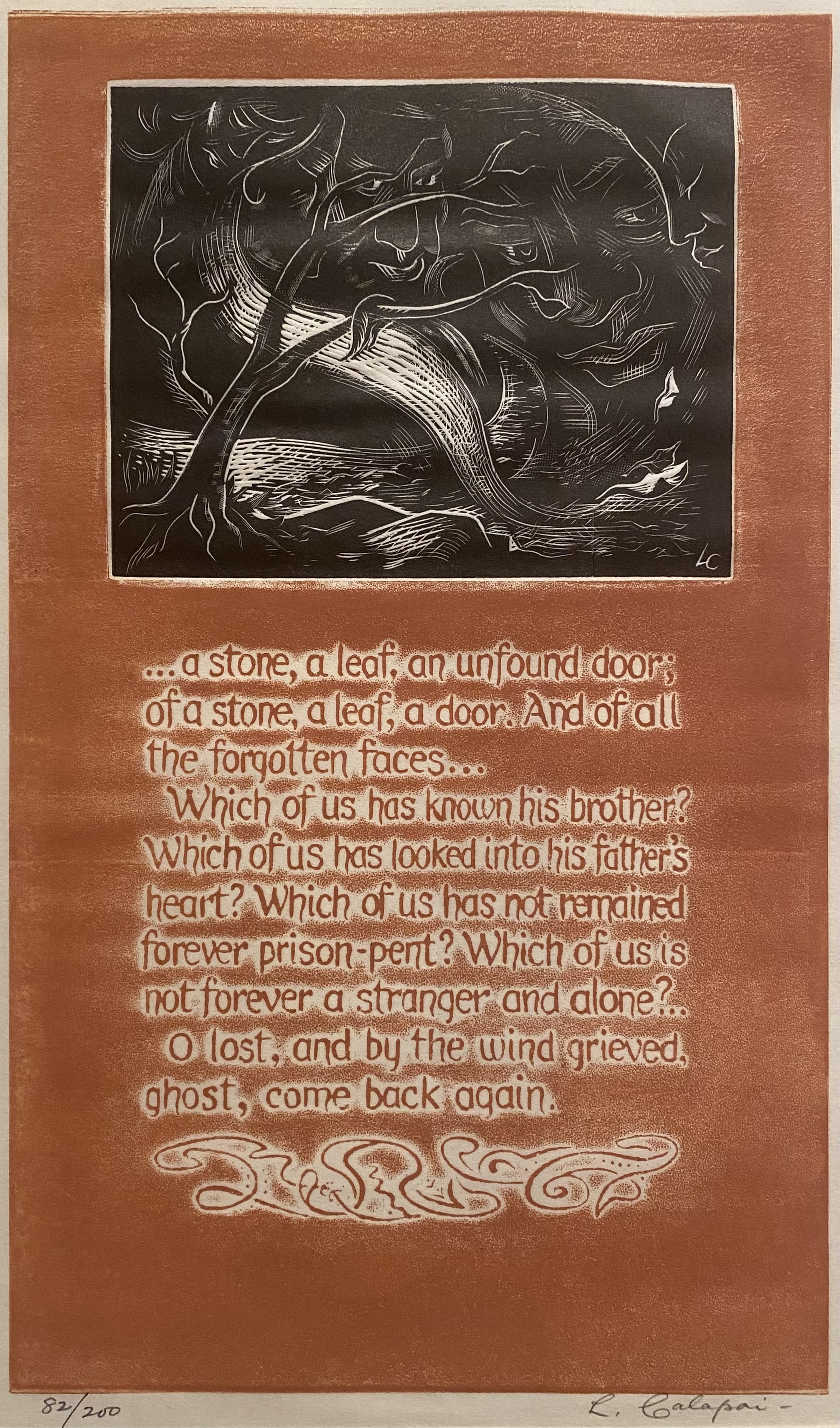
Scottish poet Ruthven Todd generated much interest in British poet and artist William Blake among the Atelier 17 members, including Calapai. They were fascinated by the enigmatic printing method Blake used to make the handwritten script that accompanied his illustrations look so natural. The group experimented with relief-etched plates to achieve a similar effect.
Calapai used the same technique for 25 illustrations to Thomas Wolfe’s Look Homeward Angel. He paired black and white wood engraved images with text. He etched around the letters making them stand out in relief. He ran the wood engraving and relief etching through the press at the same time.

Hayter revived interest in the use of engraving and appreciated the energy of the lines. We can see Hayter’s influence in Jehovah’s Eye (1949). Calapai eliminated all traces of representation resulting in flowing lines moving through space, reminiscent of the unpremeditated (automatic) drawing common among many artists at Atelier 17 and the abstract surrealists. Calapai became skilled in metal engraving and explored new processes. He impressed fabrics in the soft ground which added subtle textural patterns and tonal passages to the final print.

Calapai’s La Valse (1951) revealed his love of dance and built on Hayter’s concept of linear movement. He was close friends with modern dance pioneer José Limón and enjoyed sketching the Humphrey Weidman Company’s dance rehearsals in the late 1940s. Calapai explained, “My application of [Hayter’s] theory in “La Valse”, where I strove to interpret movement through rhythmic lines in space. The figures were a by-product. I saw the circular swing of lines creating them as seen in the foreground, middle ground, and background. They are enveloped in a trance of movement from near to far and balanced by positive and negative elements as seen in the half-tones.”i

The Calapai donation includes related impressions that allow for a more in-depth study of the artist. The FWMoA owns three versions of the Erl-king (Erlkönig) all from 1950 with minor changes to the composition and printing methods. In 1985, Calapai’s print was reproduced on the album jacket of pianist Vladimir Leyetchkiss recording, Erlkönig. For Calapai’s 91st birthday, the concert pianist flew in and celebrated by playing for him at his home.


The Erl-King is a haunting European folktale that prompted Johann Wolfgang von Goethe to write a poem in 1782. Goethe’s words later inspired Franz Schubert to compose his first published piece in 1815. Calapai brought all this together in The Erl-King II in which the composer busily writes the composition. The night sky behind him gives us insight into the story: a father rides on horseback and clutches his son while the skeletal Erl-King fights to abduct the child.

Conflagration (1957) and Earthquake (1958) are another pair of related prints and demonstrate a continued exploration of a theme. The word conflagration means a devastating fire and in this black and white version sweeping lines and forms suggest the power of natural forces. The tip of a landform looks barren with perhaps charred, defoliated tree stumps.
Earthquake is an expansive apocalyptic scene made from two plates; the right panel’s composition is essentially Conflagration. Glowing yellows and oranges fuel the fiery inferno. While an artist can add colors in layers, printing aquatinted plates separately in succession, Atelier 17 artists practiced simultaneous printing—printing all the colors at once. Calapai applied black ink and worked it into the incised lines, like a traditional etching or aquatint. Some colors were rolled on like relief prints and other colors are pressed through stencils or screens. After all inks were added to the plate, it was run through the press. Ann Shafer, a specialist in the history Atelier 17, has written a detailed description of the process in her blog post. https://www.annshafer.com/annshaferblog/archives/06-2020


Like Hayter, Calapai sought to share his knowledge. At Hayter’s recommendation, Calapai was hired to start the printmaking department at the Albright Art School (now University of Buffalo). Calapai taught there from 1949 to 1955. He was involved with setting up numerous workshops, including his own Intaglio Workshop for Advanced Printmaking in Greenwich Village (1959-1965). In addition to teaching in Buffalo, Calapai taught at New School for Social Research (1955-1962), New York University (1962-1965), and Brandeis University (1964-1965). He moved to Chicago in 1965 and taught periodically at Kendall College, Evanston and the University of Illinois.
Make an appointment or stop by the Print & Drawing Study Center Tuesday-Friday 11am-3pm to see more of our works on paper!