

Amanda Shepard, Vice President and COO

Gary Erbe brings to the fore two things that are overlooked in an art world seemingly dominated by works of abstraction, deconstruction, and disembodiment. Much of the heralded works of the 20th century are those that attempt to visualize the invisible world of concept, theory, and emotion. I confess that as a young art student I was totally infatuated with much of this work, and I still enjoy pulling out my modern art theory books from time to time. But I am even more grateful now, a few decades past those prescribed courses, for the freedom to recognize and name other worthy approaches to describing the world through art. The work of Gary Erbe is one of those.

The first thing that Erbe asks us to remember is that the objects in our lives carry meaning by virtue of their integrity as an object. Whereas some modernists found meaning in the object by dissecting it and examining it by its parts, Erbe points to an object’s meaning by contextualizing it in its integrity. He shows us what the American flag means by placing in its midst all that it connotes and conjures in our imagination: baseball, Uncle Sam, our presidents, apple pie, and the Confederate flag in its shadow. The American flag is not meaningful because it is a woven piece of fabric of red, white, and blue. It is meaningful because of the place and people it represents, where and when it is flown, and the ideals it symbolizes, which Erbe represents through the other objects he places in its midst.

The second point that Erbe’s work makes is that command of realist painting is critical to a profound understanding of each object’s significance. The modern abstractionists traded one kind of skill for another, seeing expert depictions as a distraction from revealing the true essence of either themselves or their art. But for Erbe, his work is not an exposition of his talents to mask an absence of meaning. Neither is he giving us object studies. His skill is essential to conveying the properties of an object—its proportion, texture, and color—which, in turn, are what make it that object and distinguish it from the next. It is in these distinctions that each object expresses its truth.
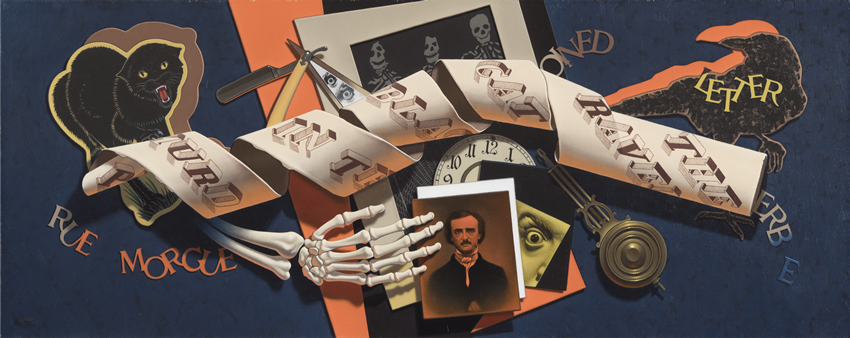
Failing to convey the truth of each object would dull the edge of artistic truth-telling Erbe wishes to achieve through his assembled scenes. And the scenes are thrilling: a perfectly rendered skeletal hand holds in place an equally convincing photograph of Edgar Allan Poe, resting atop cut paper cat and raven decals. It is only in the subtly curving angles of each joint of the hand that we are given a hint of life in those bones, just enough to make us wonder where it comes from. This is the gate that we enter, to a world of contemplation, when we look long at Erbe’s work. Let the journey begin.
To see Gary Erbe’s works in person, visit FWMoA before October 25!