

Lauren Wolfer, Associate Curator of Special Collections & Archives

When it was revealed that Jeffrey Gibson was representing the United States at the Venice Biennale, I immediately picked up the phone and texted my mom. A travel partner who shares my interest and appreciation for the arts, it seemed ridiculous at the time but “Can we go?” turned into “Looks like we should!”, and we were booking flights over Christmas break. Gibson is a favorite artist of mine, and if we’re traveling for any art festival, this was the one to see. Known for his radiant art pieces, Gibson creates anything from prints to beaded punching bags to performance pieces, producing a contemporary visual of his indigenous culture and heritage. Some artists you know will create good work for an exhibit, but can they produce a knock-out installation? Gibson definitely can (and did!).
So. Here I am. In Venice. To see Jeffrey Gibson’s the space in which to place me exhibition.

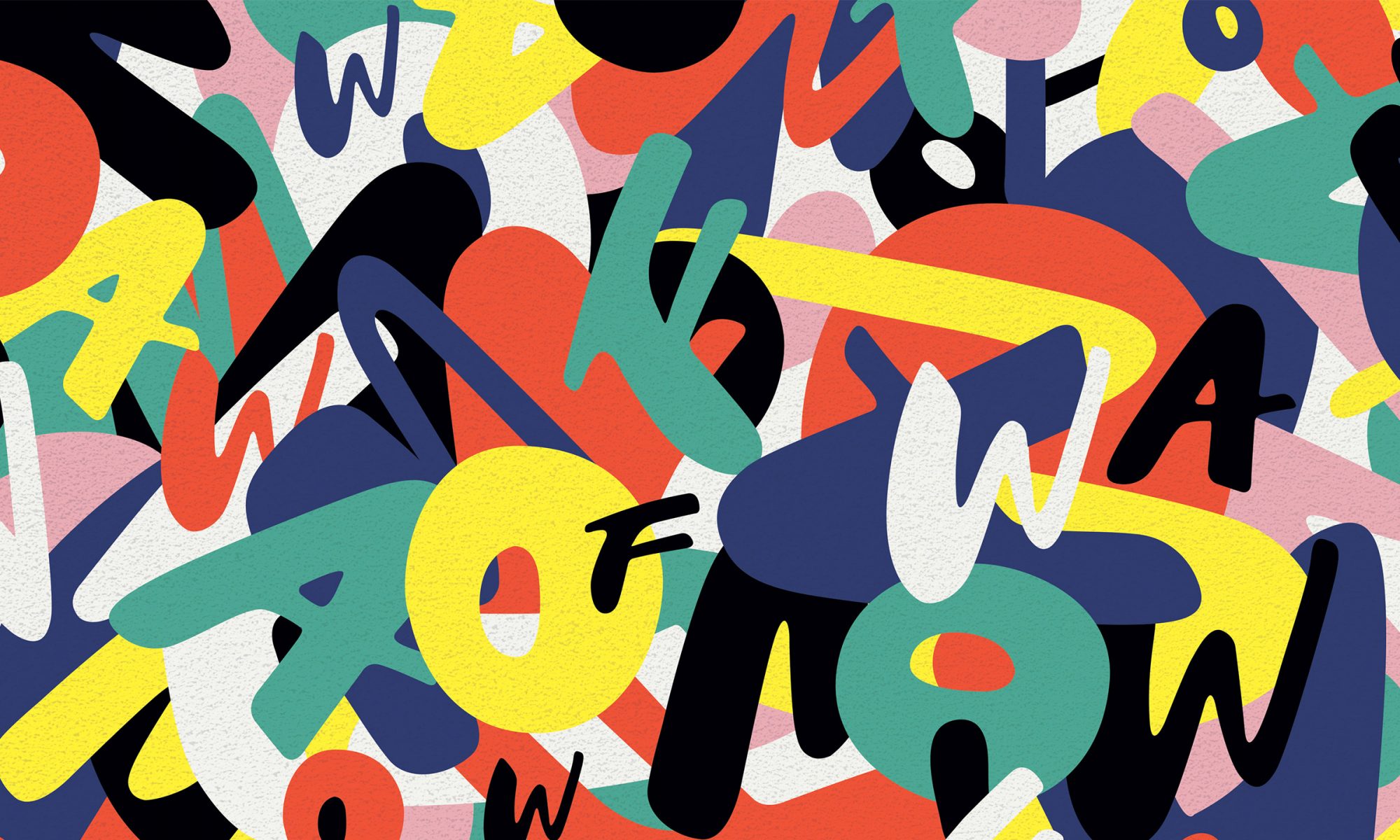
The Venice Biennale occurs every two years, with each country selecting a representative artist to fill a pavilion, or dedicated building, with an art installation. Its high prestige and popularity transforms the entire island into an immersive art extravaganza for the duration of the summer, drawing crowds from all over the world. Nearby galleries and museums join in the celebration with special exhibits. The United States pavilion, located in the prominent spot of Castello Gardens, was designed in 1930 by architects William Adams Delano and Chester Holmes Aldrich. Before even stepping foot inside, you can see Gibson’s bright colors and patterning covering the structure (above).
Each Venice Biennale has a theme, this year being Stranieri Ovunque, or “Foreigners Everywhere,” which is based on a series of works by Paris-born/Palermo-based Claire Fontaine collective. Fontaine’s works consist of neon sculptures in various languages as a movement against racism and xenophobia in Italy in the early 2000s. The phrase has a couple of meanings; one, wherever you go, you will always encounter foreigners and two, that no matter where you find yourself, you are always deep down a foreigner. The 2024 Biennale director, Adriano Pedrosa, the first Latin American curator (also the director at the São Paulo Museum of Art) set out to amplify Indigenous worldviews and make it the most diverse Biennale yet.


Jeffrey Gibson, a member of the Mississippi Band of Choctaw Indians and of Cherokee descent, is the first Indigenous artist selected to represent the U.S. for a solo exhibition at the Venice Biennale. He had mixed feelings about representing the U.S.: “There are moments where I’m proud to be American, and there are also moments when I’m totally confounded. The promise of the United States can be invigorating in a way that many parts of the world have never experienced. But promises have also been misinterpreted to empower some people and to disempower Native people. When the idea of ‘nationalism’ becomes divisive, it becomes problematic.” [BBC article]
As the son of a civil engineer for the U.S. Department of Defense, Gibson was raised around the globe in Germany, New Jersey, and South Korea. South Korea was especially impactful for him, paying close attention to pop culture influences like MTV, the street and fashion scene, and the queer culture. Gibson romanticized the idea of being a nomad; living as an American abroad gave him a sense of empowerment and privilege, and being aware of other cultures helped formulate his general aesthetic. It was when he returned to the United States that he was reminded that he was a person of color. He had differing Native experiences with both sides of his family. On one side he had uncles continuing traditional practices while, on the other side, he had grandparents who had assimilated to Christian values. Even though he did not grow up around the Native community, he did not let anyone make him feel that leaving the reservation made him less Choctaw.

Gibson’s fluidity with mediums traces back to his time in Chicago, where he studied at the Art Institute. As a student, he got a part time job as a research assistant at the Field Museum working with the Native American Graves Protection Act (NAGPRA). Since 1990, NAGPRA has both protected and returned Native American human remains, funerary objects, sacred objects, and objects of cultural patrimony. Recently, this work is significant all across the world in returning objects “collected” or stolen from tribes of ancestral lands. During Gibson’s time at the museum, it was eye-opening to him what was known and unknown; how different each object looked to people who understood it’s importance versus those who didn’t know what it was. For example, there was a prayer bundle, an object with spiritual significance, which should only be viewed by someone familiar with the ceremony, found disassembled. This was horrifying to those who understood its importance. He was interested in the notion that something can be a completely different object based on how it was viewed.
It was at this time that he experimented with materials other than paint and with different ways to work within and around traditional Indigenous culture. One of the most important aspects of contemporary Indigenous culture is to show respect to the cultural and material inheritance. It was important to Gibson to treat the materials as his ancestors had in creation, but conceive a new visual. These skills include: tanning of elk hide, beadwork, quillwork, and basket weaving. He said, “My goal was never to recreate what was made previously. I didn’t want to learn how to make baskets – I wanted to learn the technology of making a basket, so that I could then make a sculpture.” [Art in America article]

Gibson’s exhibition at the Venice Biennale includes a variety of his art-making practices: eleven paintings, nine sculptures, eight flags, two murals, and one video installation. All include learned techniques or Native technology. His aim with the space in which to place me is to upend the restrictive identities Indigenous people face and showcase the complexities of Native life in the United States. Although he does not consider himself an activist, his presentation speaks to the truths faced by Native Americans: forced assimilation, boarding schools, and the whitewashing attempt of Indigenous peoples. “We are all politicized for how we are seen. We are also advocating for our political selves, and those political selves are rooted in our ancestry and our heritages.” [Art in America article] The task of continuing the repositioning of Indigenous histories and ideas is daunting, but Gibson hopes his efforts will carry over into the future generations.


Thinking back to the theme of the Biennale, “Foreigners Everywhere”, Gibson hopes to create a sustainable inclusion in the art world for Native perspectives; for people to coexist and not feel like their ideas, or identity, will be shut down. He says, “Native people have always been a part of the world; we just haven’t always been discussed as having been a part of the world.” [BBC article]
All photos taken by FWMoA Curator of Special Collections & Archives Lauren Wolfer from the space in which to place me by Jeffery Gibson.
The Jeffrey Gibson installation was impressive. I especially loved his film installation.